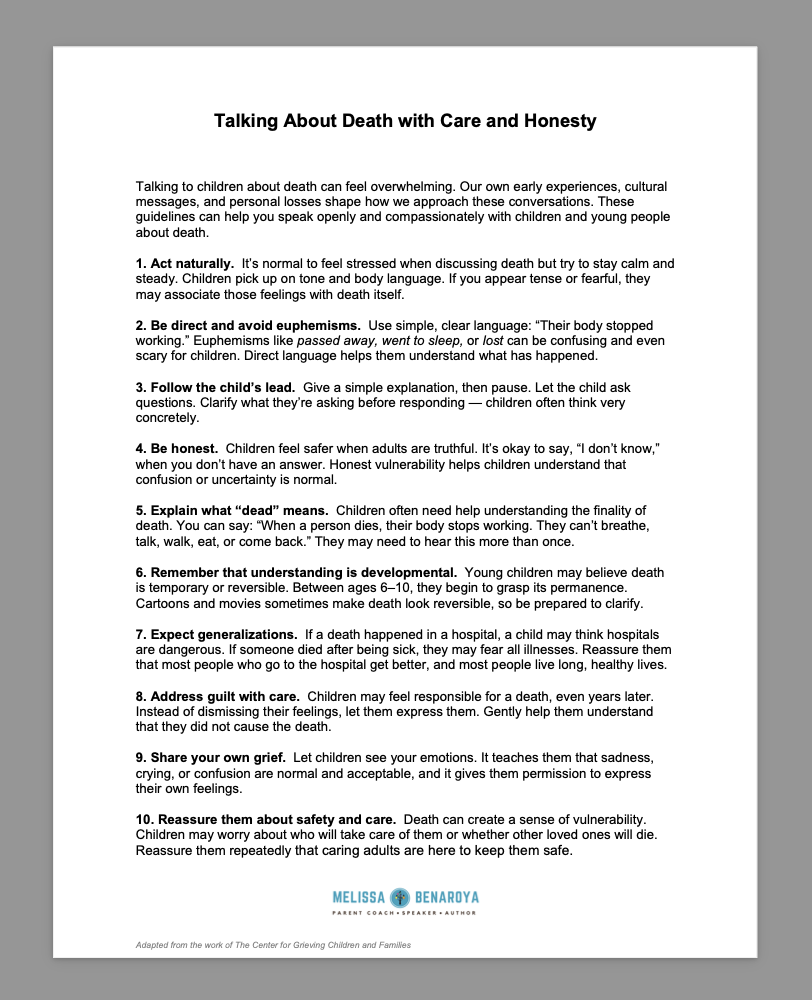
Talking to children about death is one of the most tender responsibilities we hold as parents, caregivers, and educators. Most adults didn’t grow up with open conversations around loss. We learned to whisper, to soften, to avoid. So when children look up at us and ask, “What does dead mean?” or “Where did grandma go?” it can feel like the room suddenly shrinks and the air gets tight.
Here’s the truth:
Children can handle far more than we think. What they can’t handle is aloneness, secrecy, confusion, or feeling like their sadness is something we need them to fix.
Talking honestly about death doesn’t damage children.
Silence, avoidance, and vagueness do.
Act Naturally — Even If You Don’t Feel Natural
You may feel shaky, teary, or unsure. That’s okay. Your tone matters more than your script. Children scan your face and body for meaning long before they process your words. So sit down, make eye contact, and slow everything down.
"This is hard to talk about, and I’m right here."
You don’t need to feel steady to be steady.
Children are remarkably sensitive to emotional dissonance. When our faces say one thing and our words say another, they often trust what they see more than what they hear. If we rush to reassure or work too hard to appear okay, children sometimes receive the message that sadness is something dangerous or unacceptable. Your voice may shake. You may need to pause to gather yourself. You may cry. None of that harms children. What matters is that you remain emotionally available and connected while it happens. The goal isn't to deliver the conversation perfectly. The goal is to stay present inside it together.
Be Direct
Children take language literally. Euphemisms add fog.
"She went to sleep" → sleep becomes scary.
"He passed" → Passed where?
Try:
"Grandpa died. His body stopped working. He can't breathe, talk, or come back."
Direct language actually reduces distress because children finally understand what adults have been tiptoeing around.
Adults often avoid words like died and death because they sound harsh to our ears. Yet for children, vague language is often far more frightening than clear language. Children are meaning-making machines. When adults leave blanks in the story, children fill them in themselves, and what they imagine is frequently scarier than reality. Clear language gives children something solid to stand on. Being direct isn't the opposite of being gentle. In many ways, directness is gentleness because it allows children to stop guessing.
Follow Their Lead
You don't need to give a TED Talk on mortality. Start small.
"I have something sad to tell you. Aunt Maya died. I will answer any questions you have."
Then pause. Give them room to think. Questions may come right away—or days later while brushing teeth.
If you're unsure what they mean:
"I want to answer you clearly. Can you tell me what you're really wondering about?"
Children ask in circles. Let them.
Adults often expect one conversation about death. Children tend to have twenty smaller conversations spread across weeks, months, and sometimes years. A child may ask how someone died today, whether it hurt next week, and months later wonder who was with them when it happened. These repeated questions are not signs that something is wrong or that they weren't listening the first time. Children absorb difficult information in manageable pieces, returning to it over and over as their understanding grows.
Explain What “Dead” Means (Clearly and More Than Once)
Kids often need concrete definitions to anchor big emotions.
"When someone dies, their body stops working. They don't feel pain, they don't eat or sleep or talk, and they can't come back."
You may repeat this dozens of times. That repetition is not avoidance—they're building a framework.
For adults, repeated questions can feel alarming or exhausting. For children, repetition is often how learning happens. Every time they ask the question again, they are testing the edges of their understanding and trying to fit this new reality into the world as they know it. The tenth time you answer may feel repetitive to you, but for your child, it may be the moment the information finally settles into place. Repetition is not a sign that the conversation is failing. Often, it's a sign that it is working.
Development Shapes Understanding
Preschoolers may think death is temporary, like a long nap.
School-age children start to understand finality, but movies and games blur the concept.
When they say:
“But in the show he came back!”
“In my game you get extra lives.”
respond gently:
“Sometimes stories show people coming back, but in real life, when someone dies, they don’t return.”
Clarity isn’t cold. It’s comforting.
Expect Generalizations and Fears
Children connect dots quickly, sometimes inaccurately.
"She died in a hospital. Hospitals kill you."
"He died after coughing. Coughing means death."
You can reassure without overpromising:
"Most people who go to hospitals get better. Most sicknesses get better too. This was an uncommon kind of sick."
Children work hard to make the world feel predictable and safe. If they can identify a rule, they believe they can protect themselves from the scary thing happening again. This is why grief often brings questions that sound unrelated to the loss itself: Are you going to die? Will I die? Who will take care of me? Underneath those questions is usually a much simpler one: Am I safe? Children are often seeking reassurance more than information.
Address Guilt with Tenderness
Children often believe their thoughts, wishes, or anger caused death.
“I told him I hated him.”
“I wished the baby wasn’t here.”
Instead of:
“Don’t say that.”
“That’s not true.”
Try:
“It makes sense you might think that. But nothing you said, did, or felt caused the death. Bodies die because they stop working, not because of a feeling.”
Validation first, reassurance second.
Let Them See Your Grief
Crying in front of your child is not a failure of strength—it's a model of resilience.
"I feel really sad, and crying helps my body let some of the sadness out."
When we allow children to witness grief, we show them that sadness isn't dangerous, tears aren't embarrassing, and sharing feelings is safe.
You are not burdening them with your tears. You are teaching them how to feel.
The important distinction is whether children are witnessing our feelings or becoming responsible for them. There is a profound difference between saying, "I'm feeling really sad, and I'm going to be okay," and asking a child to comfort or caretake an overwhelmed adult. When children see adults cry, recover, remember, laugh, and cry again, they learn something essential about emotions: feelings move. They rise, they fall, and they can be survived. That lesson may become one of the most important gifts we give them.
Reassure Their Safety
Death destabilizes. Even when the loss isn’t directly connected to their daily lives, children often worry:
“Who will take care of me?”
“Are you going to die too?”
“Will I die?”
You don’t have to promise the impossible.
Try:
“I plan to live a long time. Grown-ups are here to keep you safe and take care of you every day.”
And then: repeat, repeat, repeat.
Offer Multiple Channels for Expression
Children communicate grief in surprising ways. Some cry, some draw, some slam doors, some play "death games," and some ask no questions for months.
All are normal.
Many children process loss through play long before they can process it through conversation. They may act out funerals with dolls, repeatedly bury toy animals in the sandbox, or tell stories where characters die and come back to life. Adults sometimes worry this means a child is becoming preoccupied with death. More often, it means the opposite. It means they are doing exactly what children do with every big experience: practicing it through play until their hearts and minds can make sense of it. Play is often a child's first language for grief, and when we make room for it, we give children another pathway toward healing.
Closing Thought
Death is one of the few universal experiences — yet one of the least discussed. When we choose openness over avoidance, curiosity over correction, and presence over perfection, we teach children the truth: grief is survivable when we don’t go through it alone.
Your steady presence, your honest words, and your willingness to sit beside them in confusion and sadness are the anchors they will remember.
You don’t need the perfect sentence.
You just need to stay.